
What Henry County Deed Records Can Show
A recorded deed names the parties and the interest conveyed. It adds the land description, execution details, and the reference the office assigns. Read the deed type closely. It controls what the grantor purports to transfer. Never assume an ordinary arm's-length sale.
| Deed Type | What It Does | Common Use |
|---|---|---|
| Warranty deed | Conveys the described interest with stated title covenants | Conventional transfer |
| Quitclaim deed | Conveys whatever interest the grantor may hold without the same warranties | Family, estate, or title cleanup |
| Executor or personal-representative deed | Conveys under estate authority | Probate-related sale |
| Tax deed | Follows the statutory delinquent-tax process | Tax-sale property, with title cautions |
| Plat or easement instrument | Records subdivision geometry or a stated property right | Access and land-description research |
A mortgage is not a deed. Neither is a judgment or a lien. Henry County files these instrument families together at the Probate Judge's office, so watch the instrument type and any release or satisfaction entries.
Henry's Vault Coverage Begins in 1822
The Recording & Deeds office reports deeds from 1822 forward. Mortgages run from 1912 to the present. Those runs come straight from the office's own vault description. Its holdings also include plats and maps. Judgments and liens, bills of sale, contracts, and condominium filings sit there too. So do business formations, personal-property mortgages, marriage licenses, and military discharges. That span describes the physical office, not the web. The county publishes no online grantor-grantee index. It offers no deed-image subscription, and no stated earliest online year. The dependable route runs from an online parcel card to a deed book and page. Then request the instrument by phone, mail, or counter.
Note: Never describe the entire 1822-to-present span as online; the county only confirms vault coverage.
Find the Deed Reference on the CAMA Card
The parcel card carries the key retrieval detail. The public Henry parcel-card example shows deed book/page 0146-0000491 with a deed date of March 3, 1995. Those fields point the clerk to the right instrument fast. The card still falls short of the full deed. No certified chain or explicit sale price appears there. Jot down the owner spelling, parcel number, physical address, complete legal description, acreage, book and page, and deed date, so the recording clerk can separate your instrument from similarly named parties.
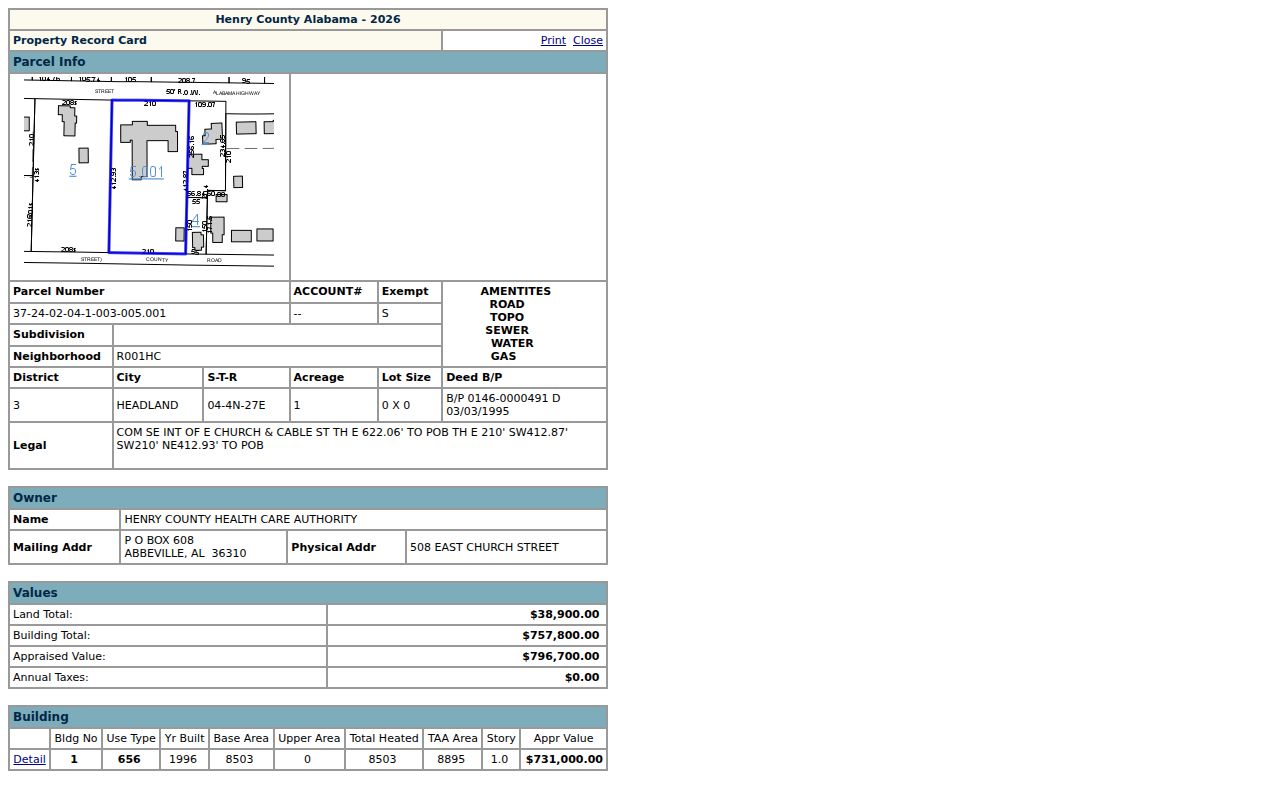
CAMA acts as a bridge, not a substitute. It points toward the recorded deed while the instrument itself stays with Recording & Deeds.
Suite A Is the Henry County Deed Counter
Recording & Deeds sits at 101 Court Square, Suite A, Abbeville, AL 36310. The office opens Monday through Thursday. Hours are 7:00 a.m. to 4:30 p.m. Call (334) 585-3371 or email searle@henrycountyal.net. Enter the courthouse and walk right. Include a self-addressed stamped envelope with mailed recording submissions. For a research or copy inquiry, supply the parties, document type, book/page, date, parcel, and legal description. General Commission records follow the separate county public-records procedure. A precise deed request starts with the recording custodian.
Walk Henry County's Grantor-Grantee Chain
A deed chain runs backward by names and land identity. With no online Henry index available, expect courthouse-assisted work rather than web search fields.
- Use the current card's book/page to retrieve the acquisition deed and identify its grantee.
- Read the grantor name and complete legal description from that instrument.
- Search the grantor as an earlier grantee, testing initials, married names, trusts, estates, authorities, and corporate variants.
- Compare land descriptions and acreage at every step; names alone can join unrelated chains.
- Repeat through deed books and preserved microfilm when current digital tools stop.
- Grantor
- The party conveying an interest.
- Grantee
- The party receiving the stated interest.
- Chain of title
- The ordered sequence of instruments tied to the same land.
- Book/page
- The Henry reference used to retrieve a recorded document; it is not the parcel number.
Names Change While the Land Description Persists
Henry County owner searches accept partial entries like the official "Jones W" example. That works for current assessment data. Historical chains punish shortcuts. Try initials and spelling variants first. Then test estates, trusts, corporate forms, government authorities, and married-name changes, confirming each candidate against the legal description and adjoining references. Probate files explain odd transfers. The Probate Office handles wills, estates, administrations, petitions to sell, and reports of sale. Its page mentions a probate records search function but offers no public interface, so counter assistance stays part of the documented channel.
Recording Fees and Copy Costs
Recordings carry a $5 transaction fee. The first page costs $6, each additional page $3. A plat runs $33, while deed and mortgage recording can add taxes calculated under the posted schedule. Confirm the total before filing. Document characteristics drive the price. The separate Probate fee schedule sets copies at $1 per page plus $5 to certify. Ask which schedule governs your deed copy, whether certification is needed, and what payment form the office accepts.
| Plain copy | Useful for research; verify current per-page charge |
|---|---|
| Certified copy | Carries the custodian's certification and added fee |
| Recording | Filing cost can include transaction, page, and applicable deed or mortgage taxes |
| Plat | County example lists a distinct $33 recording charge |
Older Deed Books and Henry Microfilm
Henry County was created in 1819, while the county's stated deed run begins in 1822. Historic research should therefore expect both institutional history and possible record gaps. A county genealogy guide reports that GSU completed microfilming Henry County records in 1989; that is a preservation lead, not proof that every original or every volume survives.
Use the Henry County research guide, Abbeville Memorial Library resources, FamilySearch catalogs, and the Alabama Department of Archives and History to identify older copies or related indexes. Historic Sanborn sheets can clarify old streets and building footprints, but they cannot establish who owned a parcel.
Plats, Easements, and Legal Descriptions
Every deed in a chain should describe the same land. For a subdivision lot, check that the lot, block, and plat references carry forward intact. Rural tracts are different. There the section-township-range calls, metes-and-bounds descriptions, acreage, and adjoining owners do the work. The assessment card abbreviates the legal text. So treat it as a starting clue and pull the recorded deed plus the filed plat for the fuller record.
The county's GIS viewer helps orient a property search with current parcels and aerial layers. Still, a mapped polygon never overrides deed language or a survey. Easements and their releases are often separate recorded instruments. So retrieve those documents rather than assuming the parcel card reproduces them.
Order a Henry County Deed Copy
Begin with the CAMA book/page reference and the deed date. Then contact Recording & Deeds by phone, email, mail, or an in-person visit; the office offers no official online route for ordering deed images. Say whether a research copy or a certified copy is needed. Give a return address. Ask the staff to confirm the current fee before you send payment.
Some deeds rest on other authority. Estate transfers call for the probate order or report as a separate record. Foreclosure, quiet title, partition, and condemnation matters live with the Circuit Clerk or through Alabama's Just One Look service. Those case files explain why a conveyance happened; they never replace the deed itself.
Recorded, not guaranteed. Henry County deed records show instruments accepted for recording. They are not a title opinion, and unrecorded interests, indexing errors, or unresolved heirs may exist.
A complete deed copy request needs more than a street address. Include grantee and grantor spellings. Add the document type, deed date, recording range, book/page, parcel number, acreage, and any legal-description clue. Streets and mailing addresses change over time. The land description persists. The sample parcel's Abbeville mailing address and Headland situs show the problem. An address alone can steer a deed search toward the wrong record.
When one deed cites another instrument, retrieve both. Mortgages need their later releases or satisfactions to show recorded status, and easements may sit on file separately. Plats supply lot and block geometry that the parcel card omits. Judgments, liens, condominium declarations, contracts, and probate orders run alongside the ownership trail. They are not the deed itself. Identify the instrument type before treating any name or date as a transfer.
For an older chain, keep a ledger. Record the deed date, recording date, grantor, grantee, deed type, book/page, and legal description. Mark spelling variants and gaps plainly. Do not smooth them over. When the chain runs into an estate, move to Probate for the will, the administration papers, a petition to sell, or the report of sale. Then return to the recorded conveyance. When it runs into litigation, open the Circuit Clerk file to understand the authority behind it. Then come back to the instrument recorded in Suite A.