
Compare the Values in Henry County Property Records
No single figure defines a Henry County property value. The assessment card from the county's CAMA system shows land, building, improvement, and appraised totals side by side. Alabama law then applies a class rate to that appraised figure, producing the assessed value. Exemptions and current limits can shift the taxable amount. A deed's stated consideration or an actual sale price remains a separate property records question.
| Value | What It Is | Where |
|---|---|---|
| Appraised value | County's full-value estimate for assessment | CAMA card |
| Assessed value | Appraised value multiplied by the statutory class rate | Assessment roll |
| Taxable assessed value | Amount after eligible relief and applicable limits | Revenue Commissioner |
| Last sale or consideration | A transfer figure, when the recorded instrument states it | Deed at Recording & Deeds |
| Land and building totals | Components supporting the appraised total | CAMA card |
Alabama publishes fixed class rates for this math. Class I utilities are assessed at 30%. Class II property, when not otherwise classified, sits at 20%. Private passenger vehicles in Class IV carry 15%. Class III covers agricultural, forest, owner-occupied residential, and historic property at 10%. Confirm the parcel's classification before running any numbers, because the rate drives the assessed value.
Read Henry County Land and Building Value Components
The county's published 2026 sample card splits land and building totals. It reaches one appraised value after those component figures. Each building row lists use type, year built, base area, heated area, story count. It also shows its own appraised figure. Miscellaneous improvements appear by code, description, and value. That layout shows how assessment data is organized. It is not a permit history or a guaranteed construction date. View the Henry County sample property card before interpreting the layout.
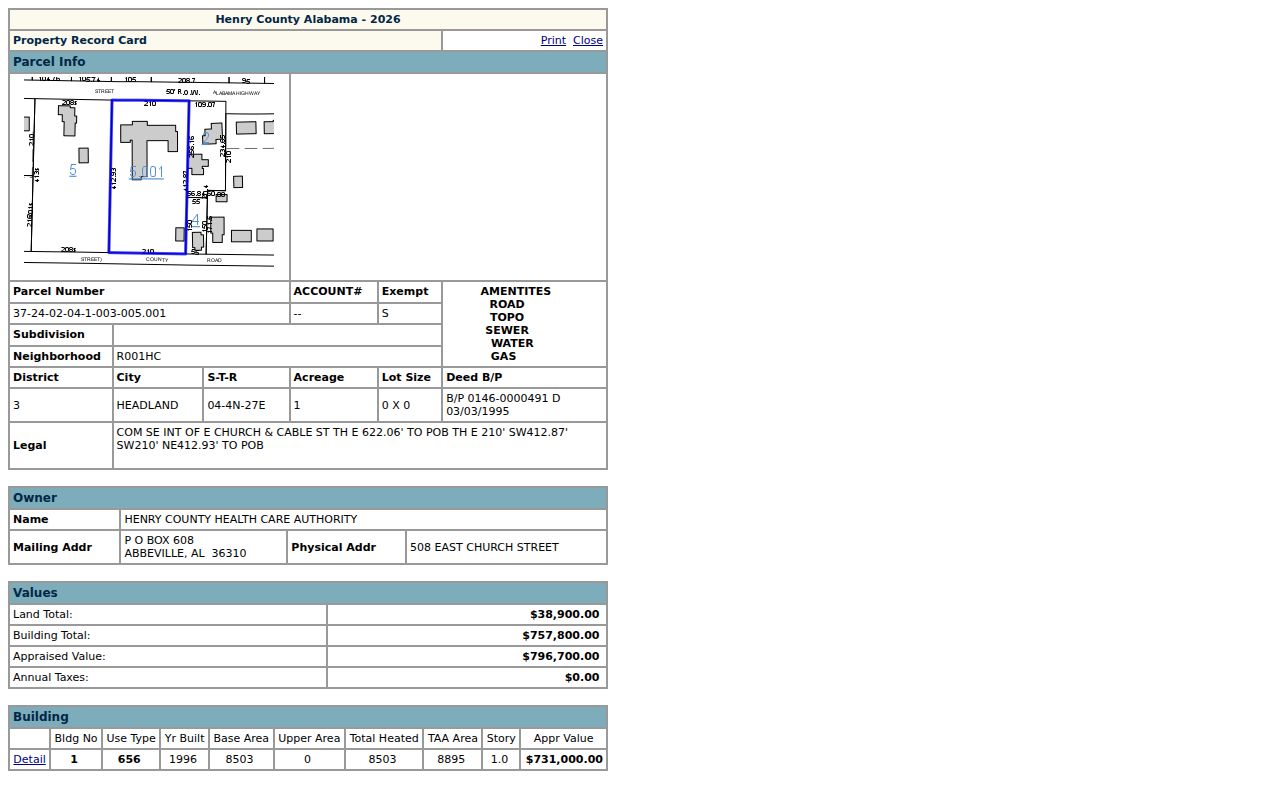
Those separate land, building, and improvement divisions let you trace a changed total to its source, whether land, a building row, or another improvement.
Look Up a Henry County Property Value
Start with the Henry GIS/CAMA public search to pull the assessment card. You can narrow results by address, parcel, owner, acreage, district, subdivision, neighborhood, or section-township-range.
- Search the physical address, preserving the difference between situs and mailing address.
- Match the full parcel number, acreage, legal description, city, and district.
- Record the card year and the land, building, improvement, and appraised figures.
- Confirm the property class and calculate assessed value from current state guidance.
- Use deed book/page at the courthouse for any sale or consideration question.
- Appraised value
- The county estimate before the class rate.
- Assessed value
- The appraised amount multiplied by the applicable assessment ratio.
- Current-use value
- An alternative basis that may apply to eligible Class III land.
- Reassessment
- A later valuation of property for the tax roll.
Apply Alabama Class Math to Henry County Property Value
The ALDOR assessment formula works in two steps. First, appraised value is multiplied by the statutory class rate, which yields assessed value. Second, assessed value multiplied by millage produces the unadjusted property tax, and any eligible relief then reduces the taxable result. This page stays with the value figures themselves; the Henry County property tax records page handles bills, exemptions, delinquency, and appeals.
Fair and reasonable market value is the usual appraisal basis in Henry County. Some Class III property may instead qualify for current-use value. Watch the class as well as the year when comparing figures, because a reclassification can move assessed value while appraised value holds steady.
Millage sits in the later tax calculation, not in the parcel's appraised value. One mill equals 0.001, and local rates can combine county, municipal, school, and other taxing authorities. Keeping that step separate prevents a tax total from being mislabeled as the county's estimate of full value.
Separate Henry County Property Value from the 7% Cap
Under current ALDOR cap guidance, annual increases in taxable assessed value for covered Class II and Class III real property are limited to 7%, subject to definitions and exceptions. That limit says nothing about market value. It also promises nothing about a future sale price. Capped taxable assessed value, appraised value, and sale price can all differ, so save the label, date, and source of every figure before comparing years.
Keep Henry County Sale Price as a Deed Question
The public CAMA card lists a deed book, page, and deed date. It has no explicit last-sale-price field. A Sale tab does appear in the public BasicSearch variant. Its live fields and value history are not guaranteed to supply an online sale-price record. Treat any such promise with care.
The deed reference still gives you a concrete courthouse lead. Match the deed's parties and legal description to the CAMA parcel. Do this before connecting any consideration to the property. Some transfers are not ordinary open-market sales. Instrument type and context matter as much as a stated amount.
Take the deed reference to Recording & Deeds at 101 Court Square, Suite A, Abbeville. The counter is open Monday through Thursday, 7:00 a.m. to 4:30 p.m. The office phone is (334) 585-3371. Even then, a deed consideration may not equal present market value.
Note: Henry County's public sources do not publish a verified revaluation cycle or closing-to-roll update lag.
Use Three Henry County Value Evidence Layers
Three evidence layers anchor any Henry County value question. The parcel card shows what the assessment system lists. The recorded deed supplies a transfer instrument and possible consideration. The GIS map adds spatial and aerial context. But none of the three replaces the others. A building visible in aerial imagery may not match the date or area on the assessment card. The map establishes no title.
For a purchase, estate, or boundary decision, note the differences rather than forcing agreement. A current private appraisal weighs the property and market for one specific purpose. The county assessment is a mass-appraisal record. It is built for the tax roll, not for that job.
Know What a Henry County Property Value Cannot Tell You
An assessor figure cannot tell a buyer what a parcel would bring in an open-market sale. It also cannot settle title, boundary, condition, permit, or repair questions. Roll rules and property-class treatment shape the number, and those differ from a private appraisal's assignment.
Value versus price. Henry County assessed value serves the tax system. It is not a prediction of sale price and is not a licensed appraisal.
Check the parcel number and card year before quoting any Henry County property value from the assessor's materials. For a current opinion of market value, rely on a qualified appraiser and disclose the effective date of the appraisal.
The 7 Percent Cap Is Not a Henry Sale-Price Trend
Alabama's guidance caps certain annual increases in taxable assessed value at 7 percent for covered Class II and III real property. The cap lives inside the tax calculation. It says nothing about fair-market value, appraised value, or what a parcel actually sold for. A deed can close far above a capped figure. It can close below one too.
When you compare years in Henry County property records, name the exact field and year instead of lumping everything under "property value." The Alabama Department of Revenue cap guidance ties the rule to the tax calendar. A capped taxable assessed value can drift well away from the current appraised figure. Exemptions open another gap between the two numbers. Before any purchase analysis, gather independent market evidence along with the recorded deed, since the tax record was never meant to serve as an appraisal.
Save a Reproducible Henry Value Snapshot
A value note you can reproduce later needs specifics. Record the parcel number and situs. Add the owner of record, roll year, land value, building value, and improvement value. Note the total appraised or market field as well. Add the assessed field, any exemption indicator, and the date you viewed the card. If a building row changed, keep its year built, area, and improvement codes too. The public sample card shows these components separately. It lists a deed date plus book/page, though it displays no explicit sale price.
Dispute a figure through the Capture CAMA Board of Equalization route. Confirm the written-notice deadline first. Alabama guidance allows a 30-day protest period from the valuation notice. Save the original card and that notice. Then Mapping & Appraisal and the Board can see exactly which field you are challenging. They can also see the roll year in the Henry County property records.