
Trace Henry County Previous Owners Backward
A former-owner search begins with the newest known deed. It steps backward one conveyance at a time. For each row, record the date, grantor, grantee, and deed type. Add the book and page and the legal description match. Henry County offers no public web grantor-grantee index. The backward chain therefore rests on CAMA clues and courthouse books. It offers no online cutoff year. Keep the working list tidy, because one skipped deed can bury the whole lineage.
| Transfer date | Grantor to grantee | Instrument | Book/page check |
|---|---|---|---|
| Newest verified date | Prior owner to current owner | Warranty, quitclaim, estate, or other deed | Match legal description |
| Earlier date | Earlier owner to prior owner | Recorded conveyance | Follow prior reference |
| Earlier book era | Predecessor parties | Deed-book entry | Inspect courthouse volume |
This is a method, not a sample chain. Never invent a transfer date or a party you have not read in a deed.
At each step, copy execution and recording dates. Include any consideration, easements, restrictions, acknowledgments, instrument identifiers, and prior-deed references. The earlier grantee usually reappears as a later grantor. But estates, trusts, corporate name changes, survivorship terms, and court orders can all interrupt that tidy pattern. Expect detours and document them.
Walk the Henry County Deed Chain in Reverse
Start with the public CAMA owner name and deed book and page. Pull the cited instrument and read the grantor, grantee, execution and recording dates, legal description, and prior-deed references. Then repeat the process with the grantor's acquiring deed until the chain plays out.
- Save the current parcel number, legal text, owner name, and deed reference.
- Request that deed from Recording & Deeds and identify its grantor.
- Search courthouse indexes for the grantor as an earlier grantee.
- Compare acreage, road names, adjoining owners, and legal description at every step.
- Continue into older deed books rather than stopping at the public card’s date.
Name variants, married names, estates, trusts, and corporations can break a simple match. The legal description is the thread that ties prior owners to the same patch of Henry County land across generations.
Henry County Vault Depth Versus Web Depth
The Henry County Recording & Deeds page states that deeds cover 1822 to the present and mortgages 1912 to the present. That is vault coverage, not online-index coverage. The county publishes no official grantor-grantee web search and cites no earliest online year.
Do not publish an online cutoff. Older and newer former-owner links may require the courthouse counter because the confirmed web layer is much thinner than the vault.
The office sits in Suite A, 101 Court Square, Abbeville. Hours run Monday through Thursday, 7:00 a.m. to 4:30 p.m. Call (334) 585-3371. County materials also describe mailed recording submissions that include a self-addressed stamped envelope.
The recording page lists several record types. These include mortgages, plats and maps, judgments and liens, bills of sale, contracts, condominium filings, and personal-property mortgages. A former-owner chain may need those records. A release, lien, or plat can explain an odd transition in the deed sequence. Use them as cross-checks while keeping the deeds themselves central.
The Henry County Card Is Only the First Link
A public 2026 card shows deed book and page 0146-0000491 with a deed date of March 3, 1995. That date proves little by itself. It does not establish a first conveyance, a latest conveyance, or the start of digitized coverage. Inspect the official sample parcel card to see where the deed lead appears.
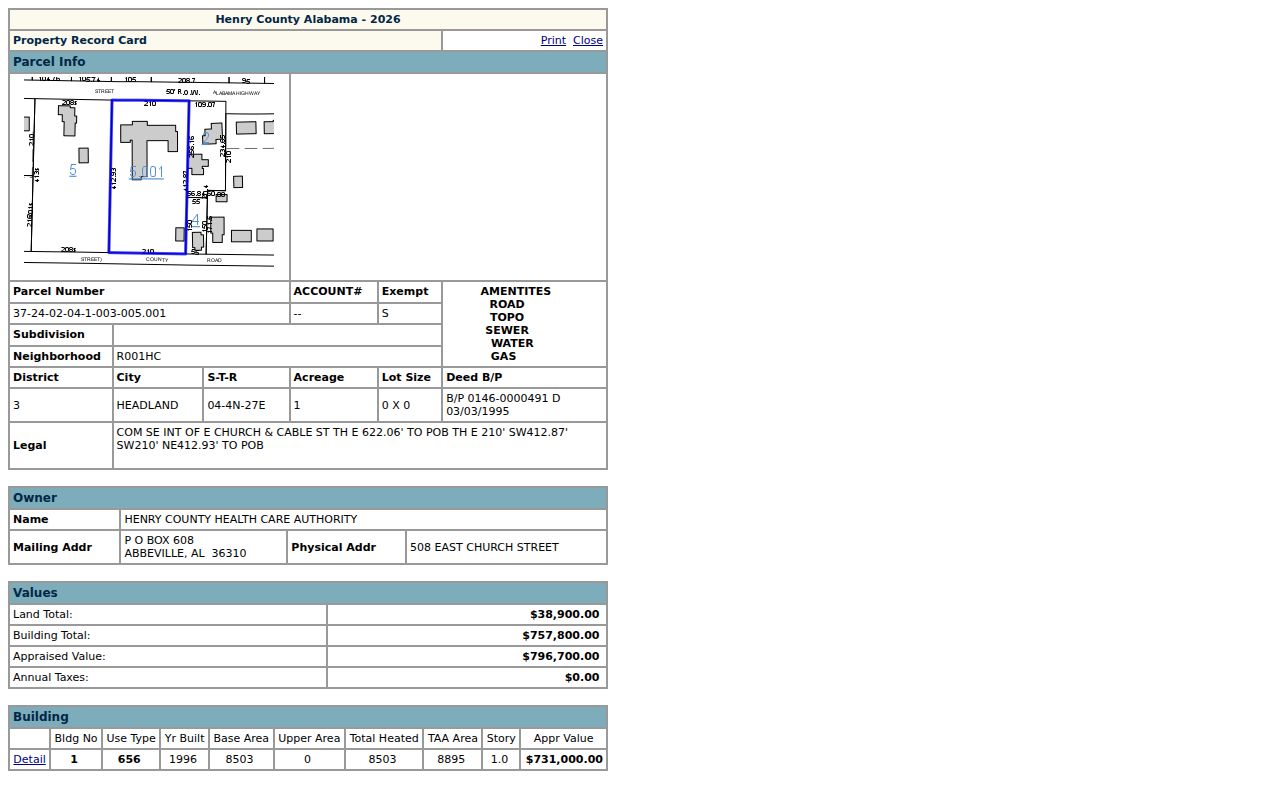
The official parcel card launches the chain but cannot replace the books. The prior grantor and the full vesting terms live only in the recorded instrument.
Define the Henry County Chain Before Matching Names
Deed vocabulary keeps the backward search precise. A grantor conveys an interest; a grantee receives it. A chain of title is the ordered sequence of conveyances affecting the land. A reverse index is organized by grantor, while a direct index is organized by grantee.
Warranty deed: a conveyance carrying stated title covenants. Quitclaim deed: a transfer of whatever interest the grantor may happen to hold, so neither label alone proves a clean chain.
Book, page, and instrument clues point you to documents. The legal description, not the modern street address alone, decides whether those documents follow the same parcel footprint.
Use Henry County Microfilm and Historic Finding Aids
ALGenWeb reports that Genealogical Society of Utah microfilming was completed in 1989. Treat that as a preservation lead, not a promise that every volume survived or is online. The Henry County research guide, FamilySearch’s Alabama wills and deeds collection, the Alabama Department of Archives and History, and courthouse volumes can help locate older material.
Abbeville Memorial Library offers local-history resources and library-computer access to Ancestry Library Edition. Henry County Historical Group publishes Siftings, but its stated policy does not include surname lookups. Confirm a volume or film before traveling because exact local directory holdings were not established.
FamilySearch describes an Alabama wills and deeds collection spanning roughly the 1700s through 2017, but coverage must be checked county by county. Use it to locate a possible entry, then compare the courthouse book and page. An archive or genealogy index is a finding aid, not a substitute for the custodian record.
Plats and Roads Help Identify Henry County Prior Owners
A parcel number can change after a split or combination. An old deed keeps the predecessor description. Filed plats, lot and block references, acreage, adjoining owners, roads, and section-township-range bridge that change. The public card's segmented parcel number and S-T-R are modern clues. They are not substitutes for the recorded legal description.
Historic Sanborn sheets offer another finding aid. Abbeville has 1907 and 1913 sheets, Headland 1916, and Newville 1949. These maps can clarify old street or block names, but they name no title holder. Use the map clue to return to a deed or plat.
Note: No Henry County courthouse-fire loss year or destroyed deed group is on record. So do not assume a gap in the chain.
Probate Can Interrupt a Henry County Owner Chain
Ownership does not always pass through a simple sale. An estate or a will can explain why one owner vanishes from the chain. A judicial sale or a quiet-title judgment can do the same. Partition cases and condemnation orders change vesting too. In Henry County, the Probate Office keeps estate and will records. The Circuit Clerk handles civil property disputes.
Match the case or estate order against the deed record before trusting the link. Check the parcel description as well. Copies of probate records come from the county office. The fee sheet lists $1 per page plus $5 to certify, and the county confirms current rates on request.
Limits on Henry County Former-Owner Research
A backward chain holds up only when each instrument is matched correctly. Similar names can fool you. So can entity changes, omitted interests, and parcel splits that quietly redraw boundaries. Gaps in the deed books create false links just as easily. A tax roll or historical map can support the search. But neither one replaces a recorded deed.
Lawful historical use. Previous-owner records support house history, estate research, and purchase diligence. Never use them to stalk, harass, or harm a living person.
Confirm the most recent name before walking the chain backward. Start with the Henry County current owner record, then log each older transfer on its own line with the source and any conflicts left open.
Keep a research row for every deed you review. Note the execution date and the recording date separately, since they often differ. Write down whether the instrument cites an earlier book and page. When the legal description shifts, compare acreage, adjoining owners, road references, and any filed plat. Do this before joining two entries into one chain.
The Henry County courthouse matters most at this stage. The vault there reaches far deeper than online access. A missing online result proves nothing about a prior owner. A clerk-assisted book search, an archive finding aid, or a microfilm lead still has to end at the recorded volume. That volume is the confirmation.